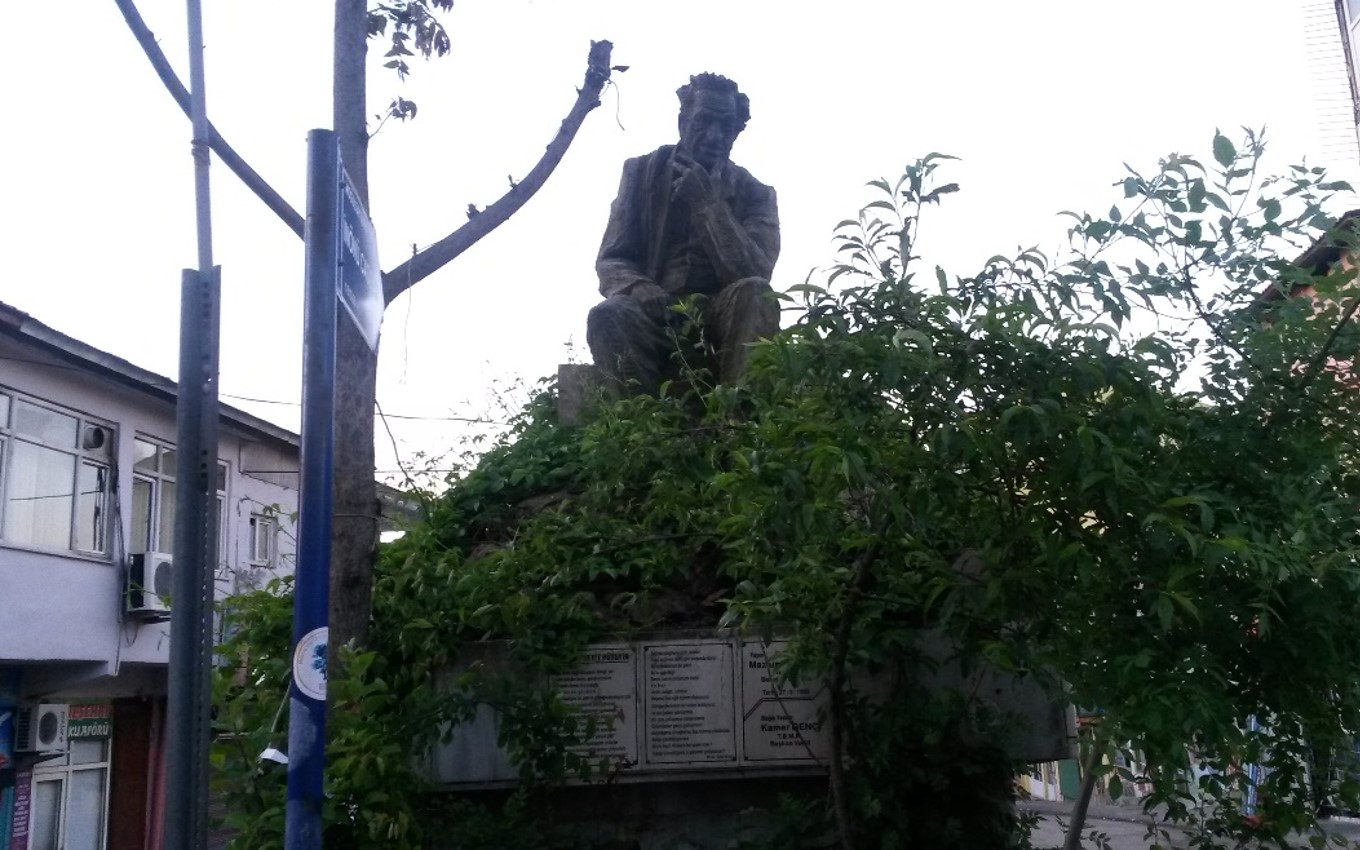
Varying according to the political positioning of different interlocutors, his madness and his death by murder have been associated with diverse acts of state violence that have marked the collective memories of the region. But what does it mean for a statue to fail forging a coherent or rather unified biographical narrative? Taking this question as its point of departure, the talk investigates the generative political power of holding diverse discourses of political injuries. It argues that the practices of remembering in landscapes of perpetual state violence require revisiting the notion of closure and the recognition of trauma as the end point. Instead, it proposes that memorials evoking open-ended narratives of injuries are potent in generating political imaginations by deconstructing ideas of bounded identities and bringing different communities of loss together.
Çiçek İlengiz’s work is situated at the intersection of state violence, cultures of commemoration, therapeutic practices and imaginations of political change. She completed her PhD in 2019 at the Research Centre for History of Emotions hosted by the Max Planck Institute for Human Development, Berlin. She joined to the research group ‘Empires of Memory’ hosted by the Max Planck for the Ethnic and Religious Diversity in Göttingen in 2019. Currently she is a short-term EUME fellow and revising her manuscript for publication tentatively entitled Magical Revolution: Holy-Madness in Post-Genocidal Turkey.
Please register in advance via eume(at)trafo-berlin.de. Depending on approval by the speakers, the Berliner Seminar will be recorded. All audio recordings of the Berliner Seminar are available via Soundcloud.